Lesson 1: Identifying One of the Three Major Traits of Reading Fluency: Rate
Lesson Overview: This lesson will introduce the essential elements of successful reading fluency by using an example/non-example format.
Resources or Materials Needed:
Selected reading passages
Chart paper
Writing utensils
T-chart assessment rubric (see Appendix D)
Recorded audio passages
Projector
Digital audio playback device
Performance Objective:
- Given oral passages, students will identify examples of proper and improper reading rate using a T-chart format with 80% accuracy.
Time: 60 Minutes
Step 1: Pre-Instructional Activities:
- Students will be seated in their standard whole group formation
- The teacher will read several different short passages exhibiting their reading fluency.
- The teacher will ask the class if the passage was read well and will follow up with an even more fluent reader as an example, Jim Dale.
- The teacher will play an exemplar, Jim Dale’s reading of the first few minutes of the first Harry Potter audio book (Rowling, J. K., & Dale, J.,1999).
Step 2: Content Presentation:
- From the above lesson introduction, using whole class discussion, students will be asked to compare both readings for approximately two minutes of silent think time.
- A large Venn diagram will be created on chart paper
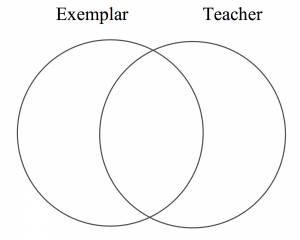
- Students will turn to their assigned group partners to discuss for an additional five minutes. They will compile their top two or three thought comparisons on sticky notes.
- Students will place their sticky notes on the correct portion of the Venn diagram.
- Teacher will think out loud describing how similar sticky notes will be grouped together
- The teacher will lead class discussions about the similarities and differences that have been compiled. A summary of the sticky notes will be scribed onto the chart to serve as an anchor poster.
Step 3: Learner Participation:
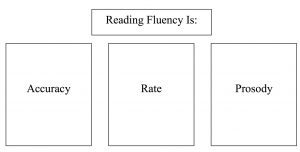
- Teacher will hang up three blank chart papers. Directing students to reflect on the Venn diagram, students will be asked to sort their ideas into what could be three main ideas. Hopefully they will determine it to be rate, accuracy, and prosody (which is a term they are not familiar with). If they don’t come up with those three categories continue on with very specific example/non-example text passages. After each reading give students time to work with their groups to discuss their thinking.
- Through guidance it will be distilled down to the correct terminologies and examples.
- Provide several more example/non-examples to solidify their understanding and record the appropriate big ideas on the three anchor charts.
- Summarize the findings, create working kid-friendly definitions, and elicit that these are three major components of reading fluency. Create a title for the 3 anchor charts.
Step 4: Assessment:
- Ongoing qualitative observation, probing questions to elicit thinking, etc will take place throughout the lesson.
- Students will be given a T-chart (see Appendix D). The teacher will display a copy of a selected passage on the projector for all students to read and follow along with. It will be read 6 times. Each time the teacher will focus on a proper example and an improper example of accuracy, rate and prosody. Students will record on their T-Chart whether the teacher is reading an example of proper or improver reading accuracy, rate and prosody. These will be collected and scored according to the rubric.
Step 5: Follow-Through Activities
- Students will be asked to find 3 exceptional examples of reading rate on YouTube. Each example must be from a different YouTube performer. Each link will be placed in the shared classroom Google Sheet.